|
|
 |
Spotted Seatrout Details |
 |
 |
| Name: | Spotted Seatrout |
| Water Type: | saltwater |
| Latin Name: | Cynoscion nebulosus |
| Common Names: | seatrout,Speckled Trout, Spec, Trout, Spotted Weakfish |
| Ideal Water Temp: | 65-81 degrees |
| World Record: | 17 lbs 7 ozs |
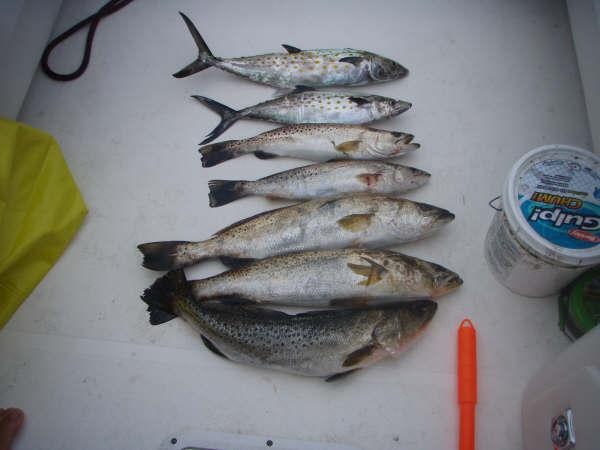
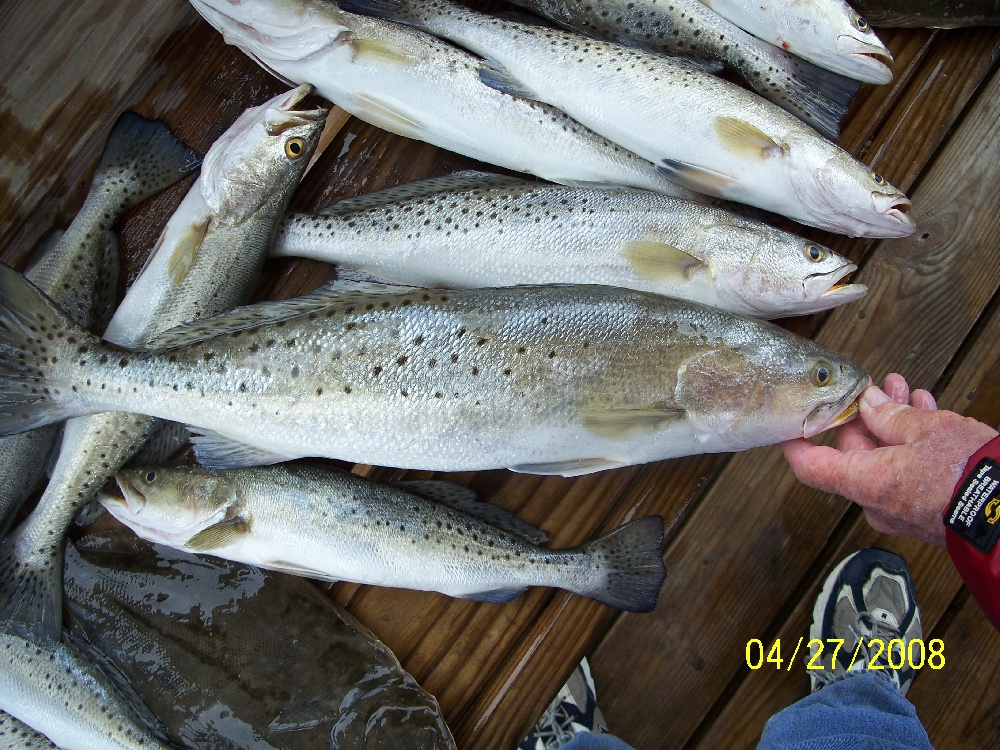
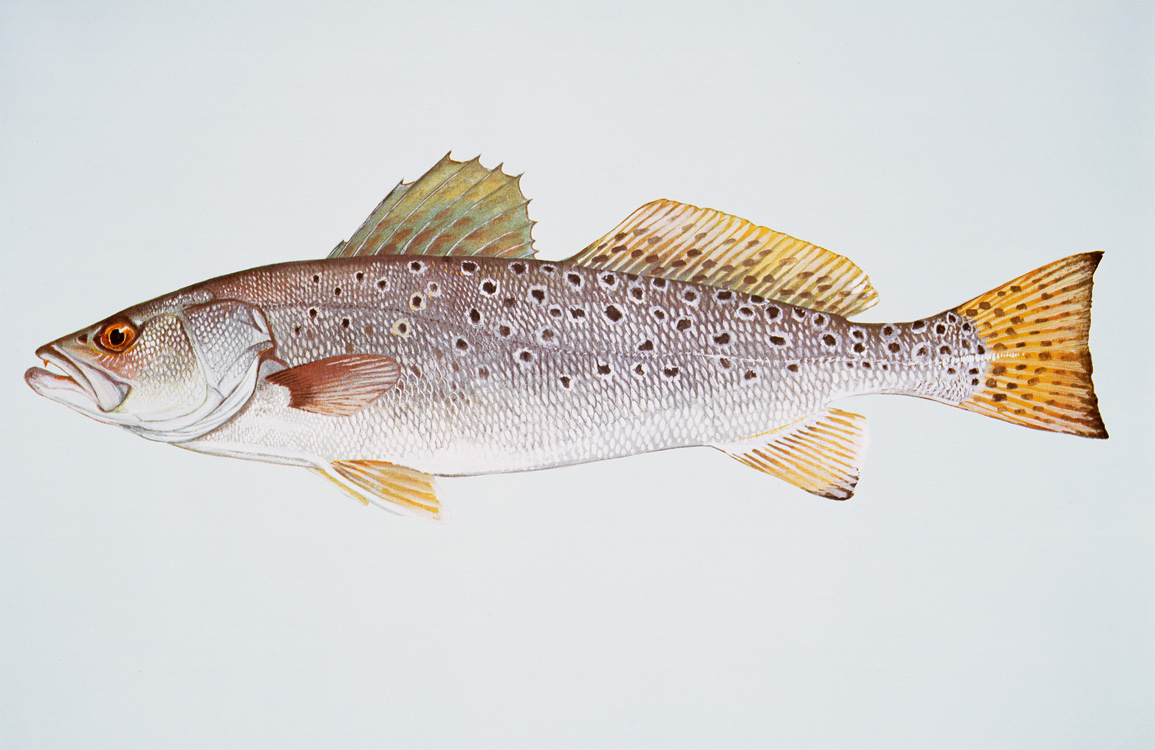
| Description: | Distinguishing characteristics include a dark gray or green back and silvery-white below, with distinct round spots on back, fins and tail; black margin along the edge of tail; soft dorsal (back) fin with no scales; and one or two prominent canine teeth usually present at the tip of the upper jaw. Males usually average 19 inches in length while females are 25 inches. Feed primarily on small crustaceans, shrimp, or small fish. Some trout caught may have worms embedded in the flesh along the backbone. These "spaghetti" worms are larval stages of a tapeworm that can only reach maturity in sharks. The worms cannot survive in man even if the seatrout is eaten raw. The worms can easily be removed when the fish is cleaned to make the meat more appealing. The spotted seatrout is a member of the croaker family (Sciaenidae) and is a first cousin to the Atlantic croaker, red drum, black drum, and sand seatrout.
Where they Are It occurs in the western Atlantic and Gulf of Mexico, ranging from Massachusetts to the Yucatan peninsula (Mexico).
How they Live Spotted seatrout prefer shallower bays and estuaries with oyster beds and seagrass beds that attract prey species. They are most common in the shallow bays during spring and summer. As water temperatures decline during fall, fish move into deeper bay waters and the Gulf of Mexico. As water temperatures warm in the spring the fish move back into the shallows of the primary and secondary bays. During periods of low rainfall and runoff, many trout often move into deeper rivers and bayous with the first cool weather of fall. Similar concentrations occur at dredged boat harbors and channels.
Where to Find Them Where to fish is just as important the proper bait and technique. During warm weather, fish shallow areas early in the morning and late in the evening. In the heat of the day, move to deeper areas such as the dropoffs around grass flats, channels or around oyster reefs. When the weather is moderate, the fish may remain in shallow water a greater portion of the day. However, during very cold weather, try fishing the deep rivers, harbors and channels. Generally these deep areas are best after a "norther" has subsided and clearing skies are associated with rising temperatures.
Boat fishers look for groups of feeding gulls during summer and fall. Schools of trout chase shrimp or small fish to the surface, which attracts the gulls. Action while fishing under birds can be fast and furious with the feeding trout taking almost any bait.
Many anglers watch and "sniff" for slicks when searching for trout. Yes, people can smell trout! Trout often regurgitate when excited (as during feeding) and the oils from partially digested food rise to the surface to make a slick. The odor has been described as similar to watermelon or newly mown grass. Other fish can also be "smelled," but a practiced nose can tell the difference.
How to Catch Spotted seatrout are opportunistic carnivores whose feeding habits vary with size. Small trout feed primarily on small crustaceans. Medium-size trout feed on shrimp and small fish. Large fish feed almost exclusively on other fish such as mullet, pinfish, pigfish and menhaden. This preference for large fish makes large trout difficult to catch. Large trout do not feed often and few anglers like to use 12-inch live mullet for bait.
The most popular terminal tackle for spotted seatrout is the popping cork rig. Best results are achieved by popping the cork periodically to simulate live action. By varying the retrieve, frequency of popping, and the depth of bait, the best action for the catching trout can be found. The best bait for catching trout is live shrimp. Live fish such as mullet or pinfish and dead shrimp can also be effective.
If the cork is removed and the sinker is replaced with a very small weight, it is called a "free shrimping" rig. The same types of bait can be used with this tackle. This method is effective when drift fishing from a boat or when fishing in areas with strong tidal flow. The bait is allowed to drift freely in water. Adjust the weight of sinker and amount of line out to move the bait up or down in the water until fish are found.
Jigs may be fished singly or in pairs either with or without the use of a cork. They are very effective fished under lights at night when trout congregate to feed. Worm jigs, fished under a small popping cork in grassy flats are effective. Try them without corks in deep guts or channels. Vary the action, depth fished and lure color. Hot pink, root beer, dark red and white are good colors.
Spoons are very effective, particularly during the warmer months. Silver is probably the best color. Vary the speed and depth of the retrieve, as well as the weight and size of the spoon. A bucktail fastened to the spoon with the hook or a bucktail and hook trailed to 12 to 18 inches behind the spoon is often successful.
Try the fishlike lures during the cooler months, although they can be effective anytime. They are especially good fished very slowly, during cold weather. When fishing shallow water during cold weather, some anglers move the point of line attachment from on top of the lure head to the snout tip to permit slower retrieval while keeping the lure off the bottom. Again, vary the retrieve, size, color, and weight. Floating lures have recently become popular with fishers stalking large trout in shallow water during the warm months. The movement of the lure at the surface may be especially enticing to trout. |
| Tips, Techniques, Discussion: | There are 6 comments for this species. Come and join the conversation.
Last comment was on 08/16/09 11:01 AM by steven_scheck |
| Recipes: | There are 7 recipes for this species. View these recipes.
Last recipe was on 02/09/10 03:59 PM by master47 |
| Photos: | Below are photos of Spotted Seatrout or locations where users have caught Spotted Seatrout. Add your own photo of a Spotted Seatrout |
|
|
| Search: | Find other fish species Find user trips that have Spotted Seatrout Find locations that have Spotted Seatrout |
| Edit Details: | Are we missing information about Spotted Seatrout that you know about? Is our data is inaccurate? If so, please edit this species. *New |
| Last Edited By: | bassprochuck on 06/04/09 10:06 AM |
 |
|
 |
|
|
 |
Sponsored Links |
|
 |
|
|